Diagnosis of Obstructive Sleep Apnoea Hypopnea Syndrome (OSAHS)
Treatment of OSA is associated with significant benefits to well-being, productivity, road safety and blood pressure control. However – even in the UK – a substantial proportion of people are undiagnosed
Diagnosis - A Sleep Clinical History
This requires assessment for the following symptoms and risk factors:
- Snoring
- Witnessed apnoeas
- Unrefreshing sleep
- Excessive daytime sleepiness, tiredness or fatigue affecting work, studies, carer responsibilities
- Poor concentration, irritability, poor memory, mood swings, mini-sleeps
- Multiple nocturnal toilet visits
- Other symptoms such as waking headaches, nocturia, choking during sleep, sleep fragmentation with insomnia, memory impairment or cognitive dysfunction
- Any comorbid disease which makes OSAHS more likely e.g.
- overweight/obese including in pregnancy
- hypertension
- type 2 diabetes
- cardiac arrhythmia especially atrial fibrillation
- stroke or transient ischaemic attack
- “metabolic syndrome”
- chronic heart failure
- moderate or severe asthma
- polycystic ovary syndrome
- Down syndrome
- non-arteritic anterior ischaemic optic neuropathy (sudden onset blindness in one eye)
- hypothyroid or acromegaly
- idiopathic intracranial hypertension
- drug history
- alcohol and caffeine intake
- history of any other sleep disorder e.g. periodic limb movements disorder.
Note
Clinical tools, questionnaires, and prediction algorithms ALONE not recommended to diagnose OSAHS in adults. STOP- BANG helpful to understand the high or low risk of OSAHS, Epworth Sleepiness Score to give a patient assessment of their sleepiness – a low score does not mean they do not have OSAHS or preclude referral.
For Primary care or other referrers to advise patients:
- most sleep studies to test for OSAHS are done at home
- maybe the same day as the clinic
- pick up equipment from hospitals/GPs /Diagnostic hubs
Primary care to inform Sleep clinic:
- most sleep studies to test for OSAHS are done at home
- maybe the same day as the clinic
- pick up equipment from hospitals/GPs /Diagnostic hubs
Diagnosis - A Sleep Study
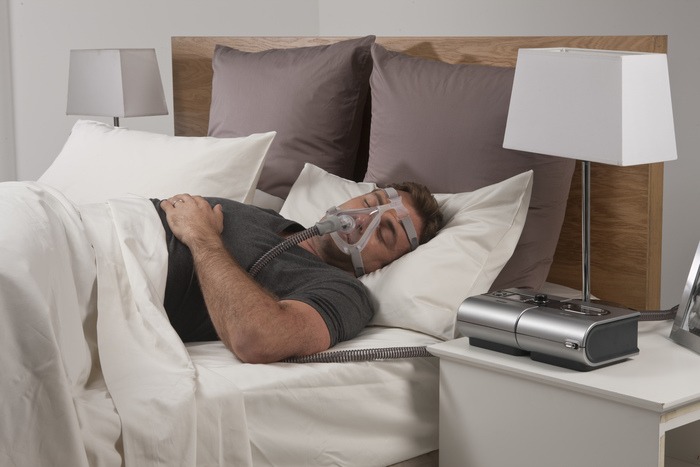
The sleep centre will decide which type. The results of the sleep study should confirm diagnosis of OSAHS and determine severity of OSAHS (mild, moderate or severe). Typically, the sleep clinic puts results together with clinical picture and decides treatment plan, which is communicated by letter to patient and GP. The severity plus symptom information will be assimilated into treatment plan.
Respiratory polygraphy
NICE guidelines recommend offering multi-channel respiratory polygraphy at home to patients.
Other options include:
Home oximetry
Home oximetry if access to respiratory polygraphy is limited but this should be avoided in people with lung or heart disease as it will be hard to differentiate cause of any desaturation. Subsequent respiratory polygraphy or polysomnography may be needed if oximetry results are negative, but the person has significant symptoms.
Hospital respiratory polygraphy
Hospital respiratory polygraphy (if available) can be used for people with suspected OSAHSHS if home respiratory polygraphy and home oximetry are impractical or additional monitoring is needed.
Polysomnography
Polysomnography (PSG, multichannel respiratory polygraphy plus EEG and EMG – mostly in hospital) may be needed if respiratory polygraphy results are negative but symptoms continue, or if other diagnoses are being considered.
An assessment of ventilatory function
An assessment of ventilatory function will be needed if Obesity Hypoventilation Syndrome (OHS) is possible, with preliminary venous bicarbonate (If bicarbonate levels are below 27 mmol/litre, OHS is unlikely) or arterial or arterialised capillary blood gases when the person with suspected OHS is awake, to diagnose OHS and assess the extent of chronic ventilatory failure.
A negative sleep study or even the level of OSA severity in a sleep study cannot exclude OSA or worse severity respectively because OSA can vary from night to night depending upon a variety of factors (e.g. alcohol intake, medication, daytime physical activity, sleeping posture, concomitant infections, colds, etc.)
Follow up
Clinical tools, questionnaires, and prediction algorithms ALONE not recommended to diagnose OSAHS in adults. STOP- BANG helpful to understand the high or low risk of OSAHS, Epworth Sleepiness Score to give a patient assessment of their sleepiness – a low score does not mean they do not have OSAHS or preclude referral.
Diagnosis of OSAHS on Sleep Study
Analysis of sleep studies is performed by trained individuals – often sleep physiologists or sleep nurses. There are set criteria by which studies are scored and training available to understand this further – please visit the ARTP website and the BSS for information on available training resources.
Apnoea ≥ 10 seconds cessation of airflow of ≥ 90% of peak signal excursion of pre-event baseline
Hypopnea ≥ 10 seconds drop of airflow ≥ 30% of peak signal excursion of pre-event baseline with either ≥ 4% oxygen desaturation (or 3% desaturation if sleep stage is known) or arousal (defined using a surrogate arousal method e.g. pulse rate rise, body movements)
(Pulse rate rises (of 6 bpm) are a reasonable marker of arousal. Pulse-transit time may be a better marker of arousal.)
The presence of snoring is helpful to classify hypopneas. Respiratory effort provides criteria for determining if an event is obstructive or central – presence /absence of respiratory effort.
Sleep study analysis gives:
APNOEA HYPOPNOEA INDEX/hour
- Normal sleep AHI <5
- Mild OSAHS AHI ≥ 5
- Moderate OSAHS AHI ≥ 15
- Severe OSAHS AHI ≥ 30
Note that normal night-to-night variation can move people from mild to moderate OR moderate to severe OSAHS severity. The cut-offs are somewhat arbitrary therefore and results need interpretation alongside the clinical picture.
OXYGEN DESATURATION INDEX ODI or 4% DIP RATE/hour
- Normal sleep ODI <5
- Mild OSAHS ODI ≥ 5-9
- Moderate OSAHS ODI ≥ 10-19
- Severe OSAHS ODI ≥ 20
OSA Alliance Workshop, September 2021 “NICE Guidelines on OSAHS OHS and OSAHS-COPD Overlap Syndrome”
Session 1 Recognising possible sleep-disordered breathing in your patients.
Following the NICE Guidelines which were published in September 2021, the OSA Alliance held a workshop with key members from the NICE Committee which developed the new guidance.
BSS/OSA Alliance Webinar ‘From Primary Care to the Sleep Laboratory: Working together for patients with OSA’
Members of ‘The British Sleep Society and the OSA Alliance joined forces to run a webinar which covers aspects of diagnosing OSA in primary care and providing guidance for referral.
Home-Testing Devices for Diagnosing Obstructive Sleep Apnoea Hypopnoea Syndrome
In December 2024 NICE published its recommendations on home-testing devices for diagnosing sleep apnoea hypopnea syndrome.


